From Dr. Strangelove to Canada and beyond, the journey's and memories of my life with G.

Thursday, October 27, 2016

The "Hill" in New Mexico...

I have mentioned Local Legends in a couple posts but they just seem to keep on coming so today I hope to polish this road apple of wisdom a bit more.

D&RG 315 on "Hangman's Trestle" Colorado - D&RG Net


We were just started on a trip from Antonito to Chama when, in the open car, I asked, "What is a local legend?"  A passenger quickly responded, "Something local folks believe that is not true."  Pretty much correct but, sometimes there may be an element of truth underneath the legend.  The question is asked  as we are approach Fergueson's Trestle which is better known as "Hangman's Trestle" because it is a great example of a "Local Legend." In this case a miscreant named "Fergueson" was supposedly hauled out of town on a "borrowed" locomotive and thence hanged at the Trestle for doing some heinous deed, or deeds.  Fergueson may have existed and likely has a historic basis yet, no record of him has been found.  The "heinous deed or deeds" bids fair as the result of a fanciful story concocted over a cup of coffee on a cold winters night in some such place as the Big Horn Section House.  This story when enhanced by a true story worthy of the Marx Brothers namely, the destruction and rebuilding of the trestle as a result of an ill conceived movie stunt, hilarity always ensues at least for a brief moment.  When the gravity of this historical affront is fully taken in the smiles fade.  

The picture above is a light freight pulled by a beautiful locomotive the D&RG #315 but I would like you to look again taking a wider view of the landscape.  This isn't about Fergueson's Trestle it is about that oddly symmetrical hill just behind the train on Hangman's Trestle and another Local Legend.  This is today's story:

San Antonio Mountain at Lava Tank - Rio Arriba County, New Mexico

The "symmetrical hill" in the first picture is one of the most prominent landmarks on the Cumbres and Toltec.  From far out on the line, beyond Lava Tank and Big Horn Wye, you can see the Mountain either on the horizon or rising beyond a ridge above the Rio De Los Pinos.  It is so ubiquitous that you lose sight of it amidst the ongoing revelations on your journey.  At times it seems to loom over everything and at others it seems insignificant.  It all depends on atmospheric conditions and exactly where you are in the journey.  As you travel further away it can look huge and as you come closer it seems to shrink.  It's all in your mind's eye and the near perfect symmetry of the Mountain.   In the top picture the train is actually closer to the Mountain than the one below but it doesn't seem thay way.  Only one photograph, "The Vista Across the Rio Grande Rift Plateau", shows the totality of the Mountain.
San Antonio Mountain from the North on US 285 - Colorado

That "hill" is San Antonio Mountain, all 10,918' of it, is located in the far north end of the Taos Plateau Volcanic Field in New Mexico.  It rises as the highest point in the Volcanic field and is considered an excellent example of a "shield volcano."  The name is derived from an appearance similar to a soldiers shield lain flat on the ground in an upright position.  It supports the wintering of a herd of over 1,000 individual Elk.  It can also be observed from as far away as 60 miles on a clear day which is typical when on the floor of San Luis Valley to the north in Colorado and from above the Rio Grand Rift Plateau to the south in New Mexico.

"The Vista Across the Rio Grande Rift Plateau" - San Antonio Mountain and the Rio Grande Rift From the South
New Mexico

How San Antonio Mountain developed could involve a long diatribe about rocks and lava but not here.  This is about legends and such so I will just try to keep it brief.

San Antonio Mountain is the highest mountain in the Taos Volcanic Field in New Mexico through which the Rio Grande Rift has torn the surface asunder.  It was formed from flowing lava about one to four million years ago, which is after the last volcanic event in the San Juan Volcanic Field - the long and violent eruption of Los Mogotes Volcano - to the north and before the events in Yellowstone far to the north.  It is formed from flowing, or sheeting, lava  produced by the volcanic action which builds up in to a "shield" shape as progressive layers of flowing lava are laid down in sheets through ongoing eruptions.

Mount San Antonio is a dormant volcano of relatively recent geological activity within the past 1.5 million years.  The San Juan Volcanic Field is generally older than the Taos Plateau Volcanic Field and even younger fields with spectacular features are to the south and west around Los Alamos.

Moving on:

On one trip last year I heard a fellow of high repute state, "Locals say wisps of steam can be seen coming off San Antonio Mountain.  Perhaps we are in for some volcanic activity there."  Yet another long-time nabob of the rails took the time to loudly correct my comments saying, "There is a caldera at the top of San Antonio Mountain."  To both of which I unabashedly state, "Balderdash."

Time for a reality check:

The first of the comments regarding the issuance of steam from the mountain is pure wishful thinking which doesn't even rise to the level of Local Legend.  If there was any sort of activity such as steam venting every federal and state agency associated with planetary physics would be all over the thing - they aren't, and it would make international news - it hasn't.  So much for that topic.

The next assertion is the presence of a caldera.  I assumed this to mean an actual cavity such as that seen in the Valles Caldera of New Mexico, La Garita Caldera at Creede, Colorado or even Los Magotes Volcano/Caldera.  The answer to that assertion is presented in two Images.

The first is a topographical map from the USGS.  This map is the top of San Antonio Mountain.  At the top is a large relatively flat area - approximately a quarter mile across with a tiny bump at the southeast corner.  It is likely this may have been the location of an ancient caldera; it appears that is not now the case.
Topographical map of San Antonio Mountain - USGS
Then again, this is only a "map" and the actual surface may be quite different.  And, so it is.  High level images of the Mountain show large rectangular swaths of trees missing.  It is as if a giant razor has mown them down; the edge of one can be seen in the right hand side and top left of the picture below.  Such regular shapes are not found in nature and they indicate two things: the Mountain has been clear cut in numerous areas and, the Mountain is generally level enough for logging activities.

Further inspection of the picture notes a curious band circumventing the "Electronic Station" at the end of the National Forest Road.  This does not appear to be cleared and may be a rock outcropping upon which trees cannot readily grow.  If the latter is the case the curvature could be indicative of the remains of a large volcanic outcropping associated with a small caldera.  This would fit with the overall character the volcanic structure.

The final image is a broad overview of the topography associated with the Cumbers and Toltec Railroad.  The yellow line wandering through the image is Colorado/New Mexico Why 17.  The Railroad generally follows to the south of that highway.  Antonito, Osier and Cumbers, Colorado are noted as is Chama, NM.  The railroad crosses the State Line 11 times and the valley of the Rio De Los Pinos and Toltec Gorge are very clear - this is the route of the railroad.   To the south and east you will note a the telltale round shape of a volcano circled with a red line.  This is Mount San Antonio.
Aerial view of the crest of San Antonio Mountain - Google Image
Conejos & Archuletta Counties, Colorado & Rio Arriba County, New Mexico
We can revel in Local Legend and speculation but the story needs no aggrandizement;  when passed to others with honesty and candor its wonder and beauty will be revealed in the telling.

The story of the Denver and Rio Grande San Juan Extension National Historic Monument is told in three parts: the People and the Railroad but first of all, the Land.  To truly know the story you have to understand all the parts and that is the task, and happy duty, of a docent - as I understand it.

j

Thursday, October 13, 2016

Building Colors on The Cumbres and Toltec

Chama Depot - Built 1899 - Restored by The Friends of The Cumbres and Toltec
This is a re-post of an entry from May, 2016 titled, "The Station Agent."  Nothing has been updated but the subject may be interesting for the avid railroader.

*************************************************

Fin, Olivia and Joe
Last night G and I took the time to view, for the first time, a comedy-drama called, “The Station Agent”.  The story revolved around three people who were essentially abandoned and managed to form a relationship through trial and error.  The lead acting of Peter Drinklage, “Fin” in the movie and you would recognize him from Game of Thrones, was extraordinary.  The other two leads were Patricia Clarkson and Boby Cannaval, both did an exceptional job.

Fin worked in a hobby shop repairing model trains.  His co-worker, and business owner, dies and the business is closed and sold leaving Fin abandoned.  However, in his will the owner leaves an abandoned railroad depot to Fin.  The story takes off from there and I encourage you to see the short sweet film.
Depot at Newfoundland, New Jersey
The object of this post is the abandoned railroad depot inherited by Fin.  It is everything you would expect, a cute little “Railroad Victorian” along the tracks with creaking doors and a dusty interior cluttered with railroad furnishings.  The structure is symbolic of the three characters in the story as they, like the depot, are all abandoned in their own way.  This symbolism is furthered by the depots cracked and patched and boarded windows with flaking white paint.

The film got it exactly right as railroads routinely board the windows and paint abandoned buildings white.  This identifies them for train crews and indicates the eventual removal of the structure by demolition. 

In a previous post I noted the various colors of buildings on the Cumbres and Toltec.  In the various pictures was a boxcar red structure, several gold structures with brown trim and a historic site filled with white buildings.  These buildings are painted the same color as found when the States of Colorado and New Mexico purchased the 65 miles of track between Antonito and Chama in 1970.

Sublette, NM Section House
The structures in Sublette, NM (Mile Post 306), a National Historic Site, are all painted white indicating they had been abandoned by the Denver and Rio Grande Railroad at some point shortly before the D&RG abandoned the line.  The windows are boarded-up with whimsical curtains and children and pets looking out.  The family of the section foreman lived in the section house and their children took the train to Antonito for school.  Orders for food and necessities were given to passing train crews and they brought back the items on the next train across.  There is also living quarters for the maintenance crews plus locomotive watering and coal bins.  Sublette also has an explosives bunker sunk into the side of a hill immediately west of the buildings.  This bunker dispensed all the explosives necessary to construct the railroad in 1880.

Osier Section House
Osier Dining Hall
In Osier (Mile Post 318), a National Historic Site, we see boxcar red structures and one large gold structure with brown trim.  The large gold structure is “new” being by the railroad within the last 10 years or so to serve as a dining room for the passengers.  The remaining structures are the original buildings at Osier which are all painted the color when constructed in 1880.

Cumbres Section House
Car Inspector's house
Cumbres (Mile Post 330), a National Historic Site, has gold buildings with brown trim.  Cumbres was a required stop to allow the “car inspector” to check the brakes when coming-off or starting the descent of the 4% grade.  As with both Sublette and Osier, a wide variety of buildings still exist at Cumbres.  At this point you may have noted a striking similarity between the three section houses.  This is due to the railroad using a standardized plan for its structures.  Similarly, at three of the National Historic Sites there is also a bunkhouse for MOW workers, of log construction, all of which are nearly identical.  The car inspector's house is unique because of the extreme rarity of this particular job.  4% grades were very rare and none were remotely like the situation at the beginning/end of the "Helper District" at Cumbres.

Chama Bunkhouse
Chama Coal Tipple
For the railroad fan the crown jewel has to be Chama.  With the exception of a new, now 45 year old, engine house, the railroad yard is a near 100 year old “time capsule” from the 1920’s.  The structures are universally gold with brown trim indicating their use at the time the line was abandoned in 1968.  The only exception is the remarkable wooden coal tipple which continues under restoration but still operates and is painted in the original boxcar red.     

Now you know the story of the buildings of many colors from the last post and that’s my story for this day.

Wednesday, October 5, 2016

End of The Season...

Outside Frame Narrow Gauge Locomotive - May, 2015

In 1903 the Denver and Rio Grande Railroad took delivery of 15 "mikado" type, 2-8-2 wheel arrangement, locomotives designated as the K27 class by the D&RG from the Baldwin Locomotive Works.  The 2-8-2 mikado type was a derivation of an 1897 Baldwin design for Nipon Railway in Japan.  Because of its balance, power and speed this type endured in general freight service to the end of steam.

The 15 K27's erected by Baldwin for the D&RG were specific designs which compensated for some of the issues related to narrow gauge railroads.  The drive rods and counter weights were outside the locomotive frame while the drive wheels were placed inside the frame.  This allowed a significantly larger boiler and tractive effort at the cost of high speed due to the small 44" drivers.  Thus, up to 1938 the narrow gauge passenger trains, such as The "San Juan Express" and "The Shavano", were drawn by small inside frame T12 types which had larger 46" drivers and light weight generating higher speed at the cost of tractive effort.  In 1938 the T12's which were built in 1895 were finally retired as the narrow gauge passenger business wound down.

The k27's in turn were replaced by the significantly more powerful K37 mikado's which were erected by Baldwin in 1925 and K37's re-engineered to narrow gauge at the D&RG Burnham shops in Denver from earlier standard gauge consolidations erected in 1903 by Baldwin.  The K27's were progressively moved to switcher duty in places such as Salida, Colorado and were thence scrapped.

The last two out of the Baldwin works survived with the last of the line, #464, moving from Salida to Durango, then on to Knott's Berry Farm in California and finally to the Huckleberry railroad just north of Flint, Michigan.  It was converted to an oil burner and still runs, shiny and new looking, on a four mile round trip each day.
Last K27 from the Baldwin Works - D&RG #464 on the Huckleberry Railroad - Stock Photo
Considered a "monster", because of her then extraordinary size, when she entered service she also gained the title of "Mudhen" as did the rest of the k27 series. K27's had a tendency to wobble, or waddle, in a horizontal plane due to the length of their drive train when operating on the early D&RG narrow gauge road bed.  When operating on the substantially upgraded road bed of the C&TS that tendency is minimized.  With an adhesive weight of over 105,000 pounds and locomotive weight of 135,650 pounds they were huge when compared to a typical narrow gauge locomotive of the era such as the 4-6-0 T12 which has a 50,603 pound adhesive weight and a locomotive weight of  70,550 pounds.  
T12 # 168 - Now being restored to service by the C&TS - Wikipedia
The K27 locomotive alone has an 18,000 pound greater weight than the total weight of both the T12 locomotive and its tender and the K27 adhesive force and tractive effort is more than double. 

The next to last off the line at Baldwin was the D&RG #463.  By the end of her life she was in switcher duty in Salida and she was headed for a very different fate than her sister #464.  When the line was abandoned #463 was shipped to the ranch of actor Gene Autry in California.  There she resided until Autry's death at which time she was given to the community of Antonito, Colorado to be placed on static display.  As luck would have it Antonito is the eastern terminus of the Denver and Rio Grande San Juan Extension National Historic Landmark better known as The Cumbres and Toltec Scenic Railroad. 

It didn't take long for the clever fellows at the railroad to figure out #463 may have it in her to handle a head of steam over 64 miles and a 4% grade.  And that is where today's story begins:
D&RG K27 #463 at Osier, Colorado - May, 2015

It was a busy morning in Chama today.  An overflow crowd boarded the train to Cumbres and beyond.  At times such as this extra cars are added up to accommodate the large manifest.  Enough additional cars and a locomotive has to be attached to act as "helper" up the 4% grade from Chama to Cumbres.  Typically the train has three or four coaches, a concession car, open car, excursion class car and Parlor Car.  On days such as this an additional two or three cars are added. 

D&RG K36 Double Headed - Stock Photo
The K36 is the real "Big Boy" on the Cumbres and Toltec.  It has the power to pull 10 passenger cars up the 4% to Cumbres.  The smaller K27 can barely manage 8 on the same grade thus when #463 is the road engine it needs a help up the grade and that job is reserved for the K36.  So it was that K36
D&RG K36 #484 - Chama, NM July, 2016
#484 was scheduled for helper duty to assist road engine K27 #463 up the grade to Cumbres this morning.  The train makes a mandatory stop on Cumbres for inspection where the helper, #484, will be cut-off to return to Chama with #463 carrying the train on to Osier and Antonito.
Chama Yard Looking South October 5, 2016 - Friends of the Cumbres and Toltec - Web Cam screen shot

As usual a big crowd gathered to look at all the equipment and see the locomotives in action.  The whistle sounded four long blasts signaling "All Aboard" and the stampede to the depot restrooms commenced.  Fortunately a Docent managed to get them directed to the train before departure.

Chama Yard at Depot October 5, 2016 - Friends of the Cumbres and Toltec - Web Cam screen shot
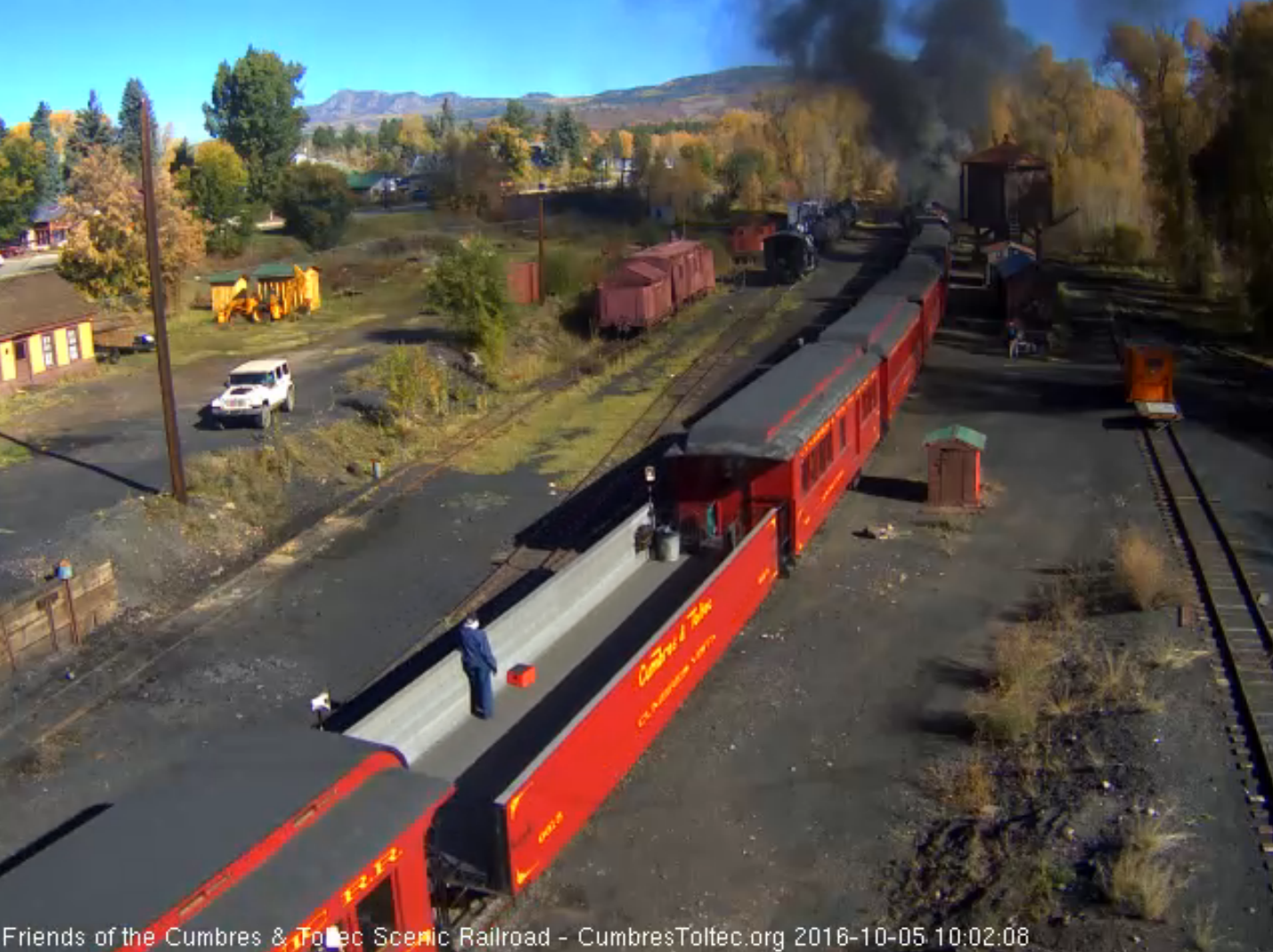
With a clear sky presaging a great trip the train pulled out of the Chama yard.  As the train left the yard the Docent was alone in the open car.  Shortly thereafter the Conductor will check all the tickets and the car will fill with passengers anticipating the wonders of Autumn in New Mexico and Colorado.  On the C&TS the passengers are free to move about the train and a favorite place to congregate is the "open car" where a running commentary is given by a volunteer Docent who also answers questions that may arise.  The rides are lengthy but it is the goal of every employee and volunteer - The Friends of the Cumbres and Toltec - to make sure our guests fully enjoy their journey.
Chama Yard & Tank Looking North October 5, 2016 - Friends of the Cumbres and Toltec - Web Cam screen shot
At this time of year the aspen trees are just past prime and the sharp brittle smell of snow is not unusual in the now chilly breeze whispering over the Tusas Range.  By October 23rd the railroad will close down for the long winter.  Coincidentally, on that date the evening temperature is forecast to fall to the low 20's with snow accumulating for the morning of the 24th.  That morning the yard will be quiet as the snow begins to accumulate over the long winter that follows.
Chama in Winter - Stock Photo
I am only a few weeks home from Chama and I miss the sound of steam and smell of the smoke; the motion of the cars and the ongoing conversation while we travel the 64 miles to the far end.  This is now a fond memory of a year filled with discovery and happiness.  Through the winter we will look at pictures and I will continue research and training for my ongoing task as a Docent.  In the fullness of time G and I will return next summer and as long as possible through the years that follow.  The people we talk with will be different, the railroad will be remarkably unchanged and the land will remain timeless.  On our return I will again have the joy of telling anew the story of the People, the Land and the Railroad that is The Denver and Rio Grande San Juan Extension National Historic Landmark.

j


Tuesday, October 4, 2016

Your point of view...

San Antonio River Walk


Today a Facebook post came through bearing a picture of a river walk in San Antonio.  The walk was described as being "Nature".  My first reaction was, "That's not really 'nature'" and I wrote a testy comment stating my "opinion" and I went on to note it was really a city, as the picture "proves", and not at all "nature."

San Antonio River Walk - another view
To totally belabor that opinion I found other river walks and sure enough all of the pictures I chose proved these river walks were in cities so certainly they could not be called "nature."

Chicago

New York City - The High Line
Denver - Cherry Creek Trail
My version on nature may look like this:
New Mexico in Autumn
But the reality is revealed in an uncharacteristic straight line which is never seen in "nature."  If one even slightly changes their point-of-view the picture looks quite different and not quite so "nature" like:
Denver and Rio Grande San Juan Extension National Historic Landmark - Colorado & New Mexico
Maybe your version of Nature will look like this:
San Juan Mountains - Colorado
Or this:
Waterfall in a forest
Perhaps this:
Super Cell
 Or something really spectacular such as this:

Great Sand Dunes National Park & Preserve - Colorado
Or even this:
Downtown Pocket Park

In a city or, in the wilds of unfettered places, in any corner of the earth "nature" can be found.  After all this effort one thing became evident - all of these parks and trails and wild places contain elements of "nature" and are intended to bring a sense of peace.  In the end nature means many things and for each of us, no matter the place, it may mean danger, joy or perhaps peace.  It's all in your point of view.

Tuesday, September 27, 2016

The Articulated Man...

In a departure from the usual subject matter, in this post I am writing about a visit from the youngest member of the Crawford Family.  I will get back to my usual posting next week.

Three days ago we received a call as we were leaving for church.  Our youngest son was bringing his wife and our grandchild up for a visit.  Because of our busy schedule we haven't seen our grandson very often in the past few months.  This promised to be a happy day, and it turned out that way.

Dom, our grandson, was uneasy with the strangers, G and I, in this very strange place.  Cats, big dogs, lots of new and unusual things surrounded him.  Dom just starting walking last week and he immediately used his new skill to explore this interesting new place. 
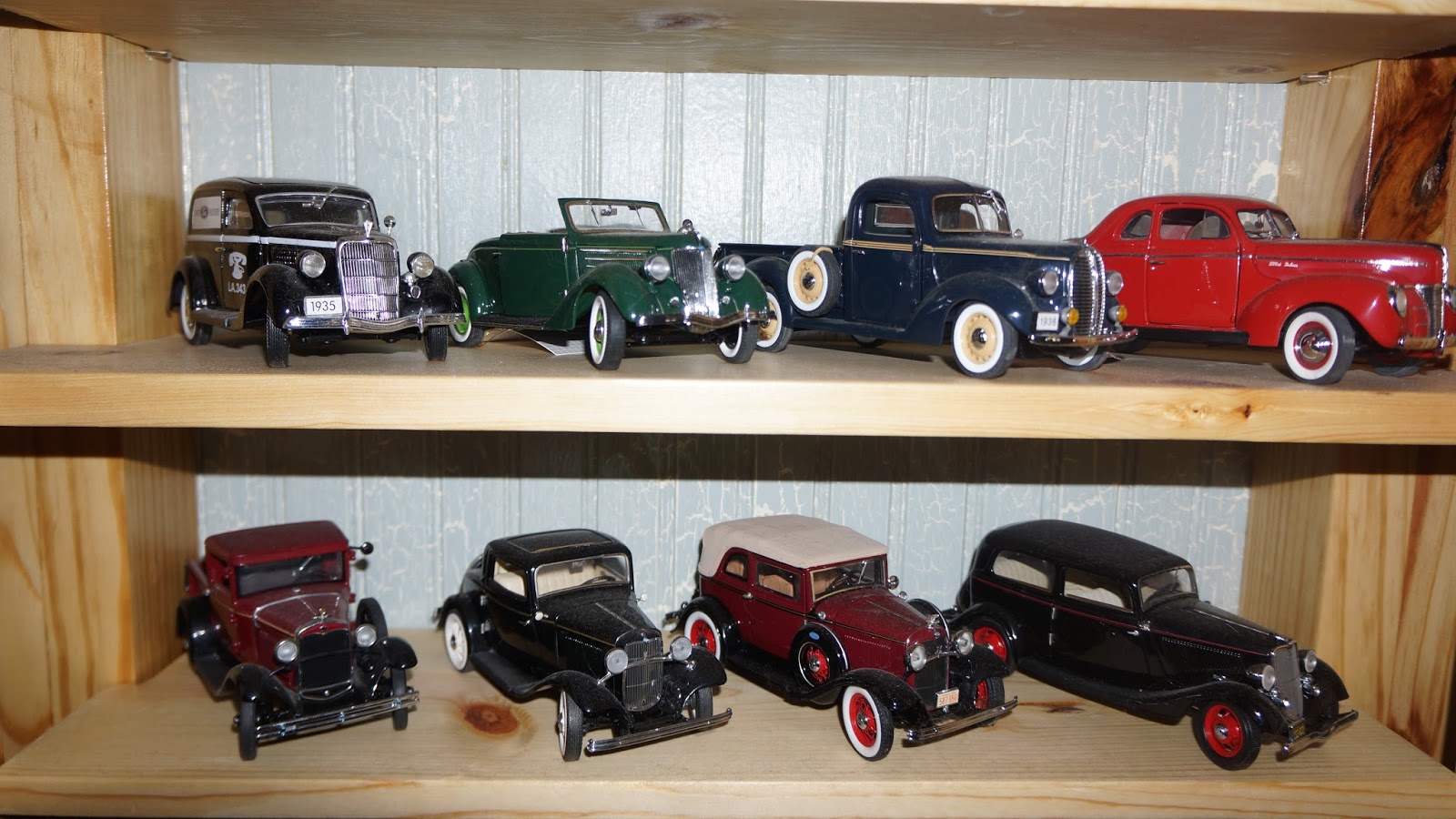
He passed by model cars and trains on shelves as they were just not
quite shiny enough to warrant attention.  As our place is far from child proofed, In the years that follow I suspect a lot of the transitory treasures upon the shelves will wind up on the floor in many pieces, a fair price to pay for a healthy curiosity - but, what are such things for?  Better the victim of of a child's curiosity than a trinket gathering dust high high on a shelf.  

As a child I recall interesting objects on the selves of my Grandfather Crawford's home.  He was the proprietor of a steel erection company and had interesting pictures and mementos accumulated from a lifetime of his construction projects.  I especially remember two objects a figurine - an Articulated Man - made of nuts and bolts with arms and legs that articulated and a painting on the wall of a Steel Worker on a Beam high over a city below.  My folks separated by my eighth birthday and with my Mother, two older sisters and I moved west from Ohio to settle in Colorado.  Over time the memory of the two cherished objects grew dim and finally vanished.

My Mother, Beatrice Connor Crawford, was raised in a poor family in the hills of western Pennsylvania along the Allegheny River.  Many children raised in the section of Appalachia came to an unfortunate end but Mother's family, though poor, was proud.  The five "Connor girls" had a well earned reputation of putting any man in five counties in their proper place.  As a child they used to teach me to say, "The only thing a man's good for is to light a ladies cigarette" and they meant it.  In the end all of the six children, five girls and a boy, managed to live productive life's and pass along the best of the family heritage to the next generation. 

Mother never remarried.  Through the years that followed and, until near her death, she served as a bookkeeper for numerous small businesses.   When we moved to Colorado she worked full time meaning that my two older sisters and I had to learn to fend for ourselves.  With the move west I became a "latch key child" long before anyone used that term.

Breakfast was easy and Mother would pack a lunch for school the night before.  When she arrived home a simple dinner would be prepared.  Pancakes, being quick and very cheap, were a favorite and as a result to this day I can't stand the things.  We ate a lot of other odd things that were cheap and easy to prepare, beef tongue and pickled pigs feet among them; we always had a meal on the table.  Delicacies were bananas, canned deviled ham, Vienna sausage or the rare package of dates or figs.  I still don't readily eat bananas because they were so cherished in my youth that they were reserved for the adults.

Odd how things learned in youth habituate into advancing age.

Over time I learned simple cooking and baking and how to take care of my own washing and ironing and, I taught myself how to sew which brings us to this days story.

Just after our son, Josh, and his family arrived he asked if we had a sewing machine.  I told him where it was stored in a small cabinet in a corner of the kitchen floor next to the range.  On his hands and knees, he promptly  he emptied most of a cabinet onto the floor insisting, "There is not a sewing machine in here."  I told him to look again and he pulled everything else out of the cabinet still insisting, "A sewing machine is not in here."  Finally I pointed to a cardboard box in the back of the cabinet and said, "Try that."

"I knew it was in here and I was only testing you."  - Sure thing. Asking if he knew how to use the machine he answered, you bet. Now, sewing is a near universal skill of the Crawford men - I wonder why - so I was not surprised at his answer.  The next hour brought his true skill level into sharp relief.

We wound up with sewing machine parts all over the table.  Thread unwound on the floor and a fair amount of unusual language.

"What are you sewing?", I asked.

"Velcro tabs on diapers", he responded.

Lindsay, Mrs. Crawford, said, "Don't mess them up they cost $400."  We were to hear that echo for the next hour and more.

Try as he could all came to naught.  Finally, after and hour, Josh did finally manage to get one sewn on.  It was well affixed but not very pretty.

"How many do you have to do?"

"Twenty-eight!"

"This looks terrible you can't put something like this on $400 diapers!"  Exclaimed Lindsay.

We weren't particularly surprised at Josh's rusty ability to sew but at that point we found out the new Mrs. Crawford had the full spirit of the "Connor Girls."

When Josh said, "No one will see them", Lindsay pounced.

After a good tussle and a big laugh we put away the sewing machine and opened the wine.  Lindsay won and the diapers are going to a seamstress for new tabs.

After supper and great conversation we bid them farewell and elicited a promise to come back soon.

So ends our story for today with this after thought.

Steel worker on a Beam
After years of struggle, time overcame my Mother and she died in western Pennsylvania in 1997.  Separated by divorce in 1949, my Father died in Pensacola, Florida three weeks after Mother's death.  G and I went through some of his artifacts in a rental storage shed and hidden in the clutter of a failed life was the painting of a Steel Worker on a Beam high over the city below.  It is on the wall of our home, a memory salvaged from years of loss.  The Articulated Man?  He is lost to the ages and perhaps enlivens the curiosity of a youngster unknown to us.

Family is a blessing - all the trinkets we value so much have little meaning when compared to this. 

j


Thursday, September 22, 2016

Wrapping-up....

It is remarkable how rapidly one slips into a "funk" when re-immersed in the everyday concerns of what we call "The real world" which were free from while in Chama.  The election continues in its dismal way with ongoing mud-slinging and lies, daily news of violence on American streets, war and terrorist actions, machination of our economic and political "leaders" all-inpall a general denial of the truly important things in life - nothing has changed.

In this case I am not exactly sure which of the worlds, in Chama or outside, is “real.”  There was a regularity, and simplicity, of life in Chama.  Conversations were polite as folks were focused on common goals while differences were set aside.  Life was intimately connected to the seasons, the slow rhythm of life and the comings and goings of the trains.  We have been told the winters are very quiet with the population shrinking to less than 1,500 in the 4,000 square mile surrounding Chama.  Only few businesses remain open: a convenience store/gas station, market/hardware store, one restaurant, a saloon and small primary/middle school. The snow drifts deep and temperatures plunge to below zero.  Life goes on at a very slow pace, so we are told. 

I think this must be the dream world but those living there are anchored to the reality of the seasons and the struggle of everyday life.  One cannot be in denial when events demand your attention.  Small things become a moment of joy.  Christmas comes and for a brief moment on a snowy Saturday the whistles sound and a train runs taking local children on  trip up to Cumbres over show shrouded tracks – then quiet until early spring.

I think our world spoils us.  We take trips to buy non-essential things and complain when things don’t exactly go the way we want.  Seemingly, we refuse to see the reality of a world in which the exact temperature in our house of place of work is of greater importance than the honesty and candor of a public official or neighbor.  When faced with a different path we too often choose the same regardless of the outcome.  We have forgotten the notion of a “mending wall” and the importance of binding ourselves to others for the common good.

Next year we leave again for our visit to that “other” world which is Chama.  Six weeks this time and the year following three months.  In the time between the visits I will be busy with docent study for there and re-organizing my tasks at work for my eventual semi-retirement in December, 2017.  Work to repair the trailer will be finished in a few weeks and it will be winterized.  During this time I will again focus on simplifying life in this world starting with a renewed effort to “Mend walls.”

I had forgotten when we first came to Calhoun and I was kindly asked by Paul to give a little talk at the Thanksgiving ecumenical service, I recited the following:

Mending Wall
By Robert Frost

Something there is that doesn't love a wall,
That sends the frozen-ground-swell under it,
And spills the upper boulders in the sun;
And makes gaps even two can pass abreast.
The work of hunters is another thing:

I have come after them and made repair
Where they have left not one stone on a stone,
But they would have the rabbit out of hiding,
To please the yelping dogs. The gaps I mean,
No one has seen them made or heard them made,
But at spring mending-time we find them there.
I let my neighbour know beyond the hill;
And on a day we meet to walk the line
And set the wall between us once again.
We keep the wall between us as we go.
To each the boulders that have fallen to each.
And some are loaves and some so nearly balls
We have to use a spell to make them balance:
"Stay where you are until our backs are turned!"
We wear our fingers rough with handling them.
Oh, just another kind of out-door game,
One on a side. It comes to little more:
There where it is we do not need the wall:
He is all pine and I am apple orchard.
My apple trees will never get across
And eat the cones under his pines, I tell him.
He only says, "Good fences make good neighbours."
Spring is the mischief in me, and I wonder
If I could put a notion in his head:
"Why do they make good neighbours? Isn't it
Where there are cows? But here there are no cows.
Before I built a wall I'd ask to know
What I was walling in or walling out,
And to whom I was like to give offence.
Something there is that doesn't love a wall,
That wants it down." I could say "Elves" to him,
But it's not elves exactly, and I'd rather
He said it for himself. I see him there
Bringing a stone grasped firmly by the top
In each hand, like an old-stone savage armed.
He moves in darkness as it seems to me,
Not of woods only and the shade of trees.
He will not go behind his father's saying,
And he likes having thought of it so well
He says again, "Good fences make good neighbours."

Monday, September 12, 2016

New RV.....

G and I finally got to laughing about all the goings on with the Chama Cabin.  We decided it would be fun to recreate a past we never had and do some sort of "Hippy" thing.  Since we were in Colorado, the pot capital of the world, this would seem a good alternative.  Sadly, this wasn't to be it was just too far beyond a broken down old banker and his sympathetic wife.

We then though to a really fun version from a movie called "Mystery Men".  How perfect a Herkimer Battle Jitney - "The most effective non lethal fighting weapon ever devised" - would be.  We actually have the plans for this one.  Sadly, all the non lethal battle equipment and armor would definitely lead to really poor gas milage.

We settled on the best of all alternatives, a Flxible Clipper.  This one is really cool and we could do real magic as its big, has a quirky design and super retro look.   

Think Curt would be into unfinished projects 25,000 to 50,000.

Bad idea.